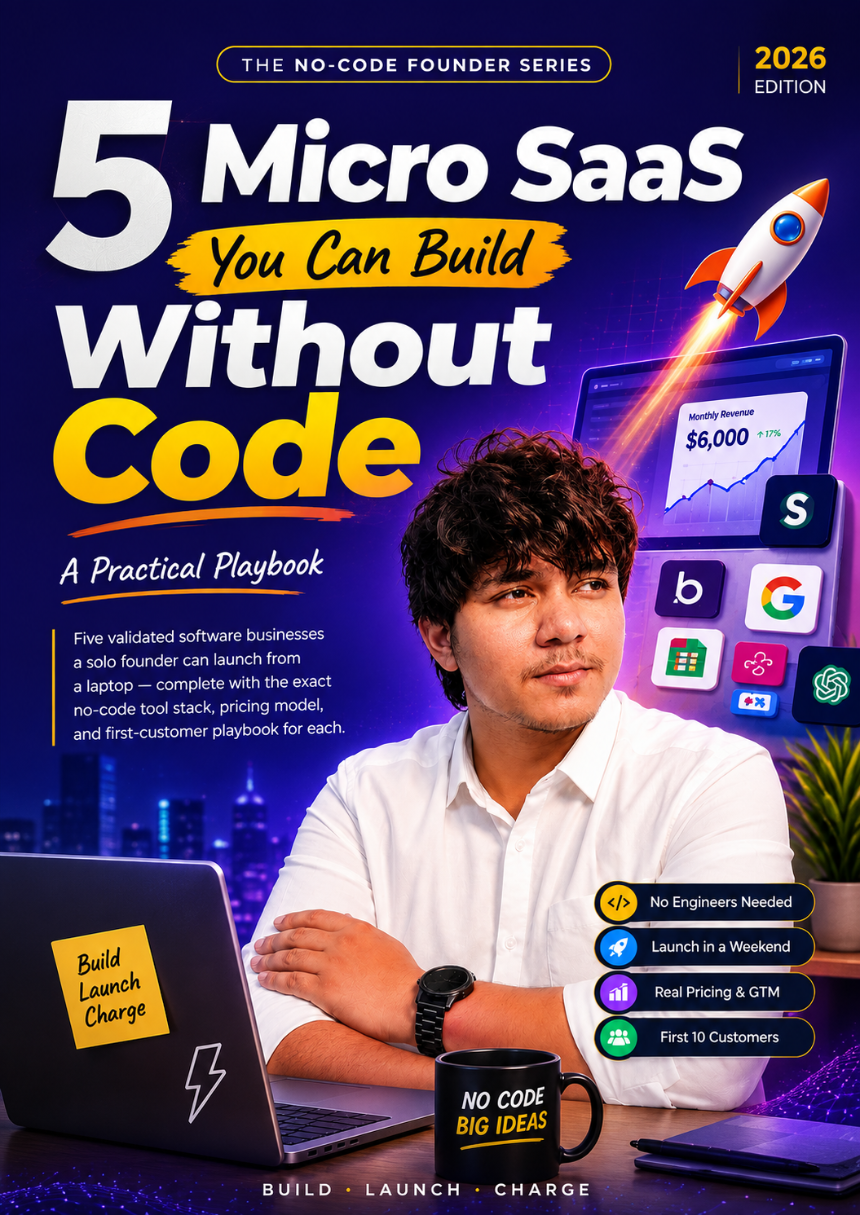
Five micro SaaS businesses you can build without writing code.
Five practical SaaS blueprints, the no-code tools to build them, realistic pricing models, and a step-by-step playbook for finding your first customers. Written for founders who can't code and don't want to wait for someone who can.
Digital access after successful payment. Revenue ranges in the book are benchmarks, not guarantees.
You don't need another business idea. You need a business you can actually build.
Most people who want to start a software company stall at the same place. They assume the entry ticket is a technical cofounder, months of development, money they don't have, and a team they can't hire. So the idea stays in the notes app.
The payments we've received, on screen.
A short screen recording of real payments coming in — no screenshots, no edits. It starts on its own; sound comes on as soon as you interact with the page.
Inside the playbook
These are not random startup ideas. Each one is a blueprint: who the customer is, what they already pay for, the tools to assemble it, and the first move you can make this weekend.
The Client Portal
A branded place where freelancers, consultants and small agencies share files, messages and project status with clients.
The Testimonial Collector
Collects text and video testimonials from customers and turns them into an embeddable social-proof widget.
The Niche Job Board
One focused board serving a single specialised industry or community instead of competing with the giant general platforms.
The AI Repurposing Engine
Takes one podcast, video, newsletter or long post and turns it into content sized for every other platform.
The Local Reputation Hub
A dashboard where local businesses monitor reviews, get alerts, and nudge happy customers into leaving one.
Pick one. Not five.
The book is explicit about this: skim all five, then choose the single idea matching a niche you already understand or can easily reach.
This isn't just 5 ideas.
It's the operating manual around them — choosing, validating, building, pricing and selling.
Don't spend weeks building something nobody wants.
“Talk to customers before you build.”
Chapter 9 walks the sequence: ten real conversations, a payment signal, a pre-sale, then the smallest version that delivers the core value.
What's inside each playbook?
All five chapters follow the same seven parts, so you can compare the ideas fairly and act on whichever you choose.
The Problem & Customer
Who has the pain, what it costs them, and why they'll pay to end it.
Why Now
Why this idea is timely in 2026 rather than five years ago.
How It Makes Money
The pricing model and the price points comparable products charge.
The No-Code Build
The exact stack and the step-by-step path to a first version.
Proof It Works
Products already earning money in the category. You're not first — you're narrower.
Your First 10 Customers
Where to find early buyers and what to say — the step most beginners skip.
The Weekend Action Plan
One concrete, small move you can make in a day or two to test the idea.
Built for people who want to build — not just learn.
The Non-Technical Founder
You have the instinct for a product but no interest in learning to code first.
The Freelancer
You want revenue that isn't billed by the hour, built for clients you already understand.
The Creator
You have an audience with a shared, repeating problem — and a tool would serve it better than content.
The Marketer
You can already reach a niche and get attention. This is the product side of that skill.
The Student
You want to run a real experiment on a small budget instead of reading startup theory.
The Solopreneur
You want one more income stream that keeps working while you sleep.
This book isn't for everyone.
NOT FOR SOMEONE LOOKING FOR
It is for someone willing to:
DO THE UNGLAMOROUS PART
Take a look inside.
The full table of contents, exactly as it appears in the book.
A no-code SaaS is four layers: an interface, a database, an automation layer, and a way to take payment.
“Ten customers at $50 beats fifty customers at $10 — same revenue, one-fifth the support.”
A complete no-code stack typically runs $50–200 a month in tool fees regardless of how many customers you have. That's the whole cost base.
Your next 30 days
The book closes with a month you can actually execute, one week at a time.
Choose & investigate
Pick the one idea that fits a niche you can reach. Do its weekend action plan. Find where those customers gather.
Talk & validate
Ten real conversations with target customers. Listen for pain and the words they use. Look for a payment signal.
Build the smallest version
Assemble the one core feature with the chapter's stack. Deliver part of it by hand if you must. Get it just working.
Launch to your first customers
Put it in front of the people you spoke to. Set it up for them personally. Aim for a single paying customer.
“But I can't code…”
That's exactly who this book was written for. Here's how it handles the rest of what's probably in your head right now.
“I don't have a technical background.”
Every build path in the book uses no-code tools. You design how data flows and what the user sees; the platforms handle the code.
“I don't know what SaaS to build.”
You get five specific blueprints, each with a named customer, a proven category and a price point.
“What if nobody wants my idea?”
That's what Chapter 9 is for: ten conversations, a payment signal and a pre-sale before you build anything.
“I don't know how to get customers.”
Every playbook ends with a first-10-customers strategy: where those buyers already gather and what to say to them.
“I don't have a big budget.”
These are small, lightweight products. The book is honest that a full stack costs roughly $50–200 a month to run, and nothing more is required.
Your next SaaS idea could start this weekend.
Pick one idea. Validate it. Build the smallest version. Get one customer.
Questions
Do I need coding experience? +
No. Every build path uses no-code platforms — you assemble the product by connecting tools rather than writing and maintaining code.
What exactly is included in the eBook? +
Three foundation chapters, five complete business playbooks (problem, timing, pricing, build, proof, first 10 customers, weekend plan), and three closing chapters on validation, pricing and a 30-day launch plan.
Who is this book for? +
Non-technical founders, freelancers, creators, marketers, students and solopreneurs who want to launch a small software business without hiring engineers or raising money.
Are these guaranteed business ideas? +
No. Each idea is chosen because comparable products already earn revenue in the category, but the revenue ranges are benchmarks, not promises. Your results depend on your niche, validation, effort and execution.
How long is the eBook? +
37 pages across 11 chapters. It's written to be read in one sitting and then used as a reference while you build.
What tools are covered? +
Interface builders (Softr, Bubble, Glide, Webflow), a database layer (Airtable), automation (Make, Zapier), payments (Stripe), email delivery, and AI services wired in through automation. Chapter 2 explains what each layer does and roughly what it costs.
Will this teach me how to get customers? +
Yes — that's a large part of it. Each playbook has its own first-10-customers section, and Chapter 10 covers pricing, tiers and the manual outreach that lands early buyers.
How do I receive the eBook after payment? +
After successful payment you'll be redirected to the download page, where your copy is available as a PDF. If anything goes wrong, use the contact link in the footer.
The ideas, pricing, tools and revenue ranges in this book are provided for educational and illustrative purposes. Software pricing and features can change — confirm current plans with each vendor. Revenue examples are benchmarks, not guarantees. Your results depend on your niche, validation, effort and execution. Nothing here constitutes financial or legal advice.